Revival without a Ransom???

Ever since the widespread persecutions got underway, I have been wondering about what the right Christian response to this ought to be. This is a painful and uncomfortable question to both reader and more so the writer because the writer ought to be aware that he would be judged by the King as per what he writes. In this writeup, I do not endevour to critic the Christian reaction or give my opinion on an good action plan to realign the Christian activity in India. I am going to try to delve into the underlying thought patterns and Christian convictions which are the impetus behind the Christian reaction.

The moment the persecutions started Christians have invariably jumped on the bandwagon of cranking the diplomatic mechanism to prevent a conflagration. The Christian egroups were flooded with what letters to be sent to ddresses of government authorities, rallies were organized, much was done to get the attention of the government and the media. Using the diplomatic avenues wisely is important, after all Paul used his Roman citizenship when it was wise and expedient to do so.

But the fundamental question one has to ask oneself is “why are the Indian metropolitan Christians so eager to get help by resorting to diplomatic channels?” is it because they want the plight of the poor tribes being hunted down in the jungles in Orissa to end soon or do react so because of the vested interests closer to their homes so that they wouldn’t themselves, because of unmitigated persecutions, have to face the thrust of the Trident in their big cities?

Empirically, Christianity has only spread when the blood of martyrs made the soil fertile for a huge harvest. Christian blood is the ransom for the gospel to have a substantial effect in any society. Even God had to give a ransom to usher a new age of freedom in human history. Even God was nor exempt from having to pay a ransom. Without ransom there can be no revival. But as I keep watching the reaction of the Indian metropolitan Christians, I seem to feel that they somehow want to be exempt from the necessity of the ultimate ransom – the Christian martyrdom.

The covert duplicity in the Christian reaction was clearly brought recently, when a Church was attacked in Mangalore, one of the most literate cities in India. The pastor of the church said to the Hindu fanatics who attacked them, “you guys got the wrong Church, in our church we don’t go about preaching the gospel to the non-believers, other churches preach the gospel to non-Christian, but we don’t. We don’t deserve to be punished so…”. The idea of having to pay a ransom for the Christian cause was too painful and unnecessary to these city churches.

This is a stark contrast to the attitude of the western missionaries during the early part of this centuary. In China the Boxer revolution of 1900 made martyrs of close to 200 western missionaries. The very next year, in ships from the west, close to 200 western missionaries landed on the Chinese shore to take the place of the martyred missionaries. Why? because they were inspired by the example set by their precedors. How? because that is Christianity at work where the followers of the King try to imitate His example of sacrifice. It was this attitude of great Christians that made Christianity to be global force to be reckoned with.

But before wondering if much of the Indian Christian reaction was Christian enough, one has to wonder how comfortable each of us is with the idea of martyrdom. “Would I be willing to be a martyr for Christ?”, “Would I lay down my life for God’s glory?”, “Would I be willing to be a martyr just to prove that I am ALL, God’s alone?”, “Would I be willing to forego all the dreams and passions of my life for the sake of Christian martyrdom?”, “Would I or would I not, that is the question.” Every Indian Christian ought to ask oneself these costly questions. Afterall, Christianity was never cheap.

The answer would be “Yes, I would”, if the greatest dream and passion of my life is to be considered worthy of partaking in the ultimate ransom by following the example of the greatest Martyr ever to have walked this earth. St. Peter did not even consider himself worthy of equal (similar) partaking with Christ and hence he made a plea to be crucified upside-down. No wonder Christ choose Peter to be the rock upon which the Church would be built. In the early Church, when martyrdom as considered an unequalled privilege not many would be worthy of, Christianity spread like wildfire.

In our cosmopolitan Churches, the idea of martyrdom is relegated as unnecessary and may be even archaic. The Indian cosmopolitan Churches need more Peters. The more Indian Christians are willing to be martyrs claiming their place closest to God, as flames in the ‘crystal lake’ before God’s throne, the more the Church would grow as a wildfire, after all there cannot be a revival without a ransom.
The most captivating Lovesong

Today is the ‘Women’s Day’ in Diosces of Madras. I was a the evening eucharist service at the Cathedral and a special solo was sung after the lessons. It was a beautiful love song and I was initially thinking it was about God as the Groom and we as His bride but somehow that did not fit the context of the song, then I remembered that it was the special song for the ‘Women’s Day’ and I read it over and over again because it was such a captivating love song.

In Native Worth and Honour Clad – Haydn’s “Creation”

In native worth and honour clad,
With beauty, courage, strength, adorn’d
Erect, with front serene, he stands,
A man, the lord and king of nature all.

His large and arched brow sublime
Of wisdom deep declares the seat!
And in his eyes with brightness shines
The soul, the breath and image of God.

With fondness leans upon his breast,
The partner for him form’d,
A woman, fair and graceful spouse
Her softly smiling virgin looks,
Of flow’ry spring the mirror,
Be speak, him love, love and joy and bliss.

*****************************

It describes Adam and Eve. And may be it is a wee bit partriachal. And the soloist that sang this was male. No matter how manytimes I read this, the words just leap out to touch my heart.

Walking in the Rain

It has been quite sometime since I had played in the rain, last time was back in June at the Sishya camp (/emmanuelreagan/2008/06/wandering-in-rain.html). Then again I got a chance to walk in the rain when I was at my home for Independence holidays and suddenly it began to rain. It wasn’t anywhere close to the Sishya rain, but it the droplets were fast and chilling and they pricked my skin.

I went to the terrace of my house and looked into around… and wondered how a rain could change the face of the land. No matter how beautifully man may make his Babel, with one rain its entire appearance is superceded with the beauty of the rain.

I wonder when my wonder for the rain would cease to be. I wonder if a day would come when I would see the rain and wouldn’t go out to be drenched in its beauty. I think if I were to see a day that is so I would rather not ‘be’ at all. It is better not to be at all than to be and see no beauty in life. In heaven life shall forever be beautiful and we shall forever be.

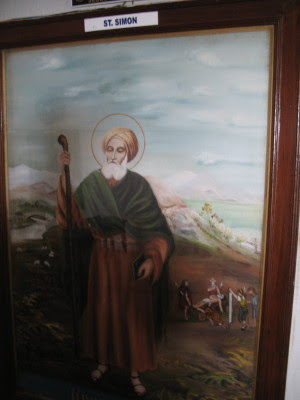
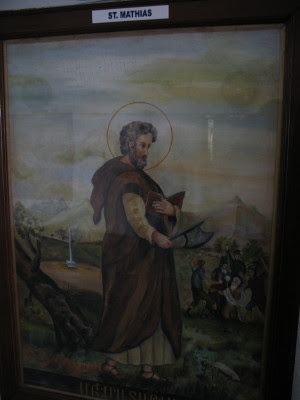
The Paintings of Great Martyrs – St. Thomas Mount Church

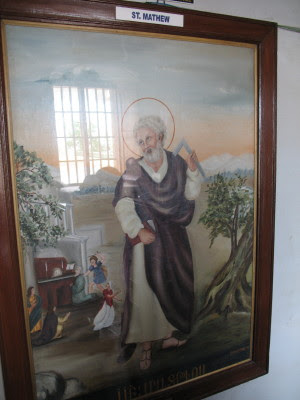
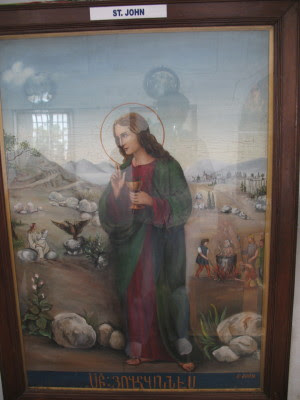
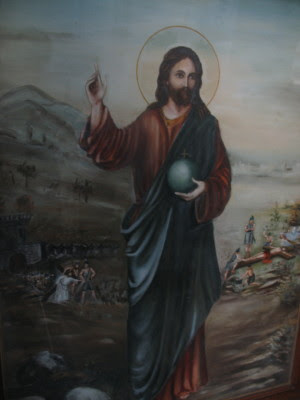
I took snaps of the wonderfuly conceptualized paintings of the Disciples of Christ in the St. Thomas Mount Chruch. There are two things I like about the paintings.

1. In the corner of each painting it is depicted how the disciple died.

2. In some paintings the disciples hold in one hand what they are traditionally known to be special for. For example St. Peter hold the key, traditionally he is believed to have the key to eternal life. What I specially like ‘liberty’ the artist used to ‘conceptuatlize’ some of them to be holding in that other hand – the instrument of their own martrydom. This is why I think this art is classic.
This is a beautiful idea. I am not sure why some disciples do not hold their instruments of death, I wonder if there is a tradition behind why only some disciples are depicted so. The artist seems to depict each disciple’s acceptance and may be even pride in his means of martyrdom. This I think is real artist at work. Such artists create simple beauty and conceptualize astounding profoundity, what they creates is timeless.

St. Simon – sawed apart

St. Mathias – holding the axe

St. Paul – with the soward

St. Bartholomew – holding a soward that would kill him

St. Thomas – speared to death (no wonder by a guy wearing a turband and dothi)

St. Mathew – holding a sickle.

St. James – holding a club he’ll be clubed with

St. Thaddaeus – holding a stump

St. Peter – holding the key to eternal life. Inverted crucifixion.

St. Andrew – The diagnol shape of his Cross made it to the Scotish Flag, St. Andrew being the patron Saint of Scotland.

St. James – beaten to death

St. John – boiled to death

St. Philip – holding a Cross in one hand and a Book in the other.

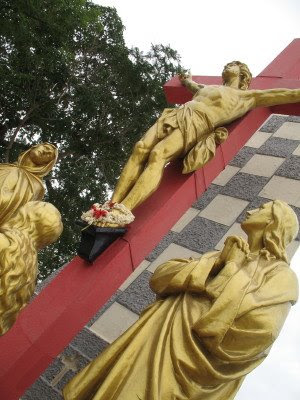
Our Lord carrying the cross to calvary and being nailed to the cross. The world is in His hands, won over by the cross. Setting the first example by taking pride and being victorious through martyrdom for us to follow through. Would we?!?!?!

The eyes of the Beautiful Lady

I was watching Bill and Gloria Gaiter’s Home coming series which is my most favorite Christian song collection. In one of those the famous song written by Annie Johnston Flint ‘He giveth more grace when the burdens grow greater’ was sung by the whole group.

A couple was invited to sing the second stanza. What struck me so much by the way the couple sang was the eye of the lady. The guy seemed so professional in his style, his body gently swaying, his face was pleasant, his expression polished, he was looking at the audience and even smiling a bit. In contrast the lady seemed frigid, her face was even a wee bit contorted.

But there was something so endearing and heavenly about her demeanor in spite of the unsmiling contorted expression she wore. It was her eye, it was focused not on the audience, it had a transcended look it was looking very far into something that other’s hadn’t the sight to percieve.

She was looking at God, she was performing for Him not the audience so she did not even know that she looked a little frigid and unpolished next to her suave husband. Her frigidity was not because her body was tensed but because in the awesome reverence it exuded, it dared not to make the wrong move. All she care about was being focused on the Hero of the love song they were singing and consequently a bit of His transcendence passed into her and gave her demeanor a heavenly aura which most other singers of the day lacked.

She was singing to her King and that is all that mattered to her, it was so apparent in that eyes of the Beautiful Lady that were lost in Him.

St. Thomas Tour – the unexpected ways of God

Our youth group had planned for a St. Thomas tour on 15th August – a kind of a picnic to St. Thomas Mount and St. Thomas memorial at Little Mount. I said I wouldn’t go because I would be at Tirunelveli for Independence day holiday. I missed booking the train ticket so I booked ticket in bus for 14th evening 6:00 PM.

I was in the bus stand by 5:20 PM and started searching for the bus which I was to board. Out station busses would be in platform 1 or platform 2. For 40 minutes I was searching for the bus which I was meant to board and couldn’t find it. I missed the bus. I cannot believe that a bloke as I wouldn’t be able to find a bus to board in 40 minutes. It is just too incredible. I think I was completely blinded. I believe God did not want me to go home, he wanted me to stay at Chennai on August 15th and go for the picnic with the youth folks. I booked my ticket for the next evening, August 15th and called up Reeba and told her I would come for the picnic.

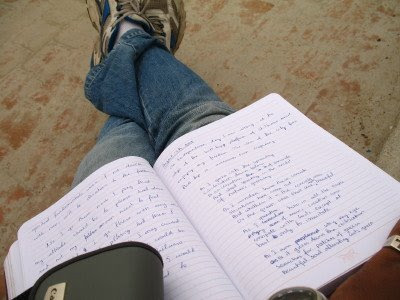
Slept at about 3:00 am early 15th morning as I was writing some stuff and woke up very late and couldn’t go to Church from where folks started by van. I called Reeba and told her I would go straight to St. Thomas Mount and wait there. I also took with me my journal as I knew that awesome sight from up there would be inspiring and I could write a poem there. I wrote an essay of a poem over a couple of pages sitting at the edge of the hill-top platform and looking into the vast expanse before me.

Just after I completed the long poem, folks joined me there and we had a good time. Below are a few snaps.

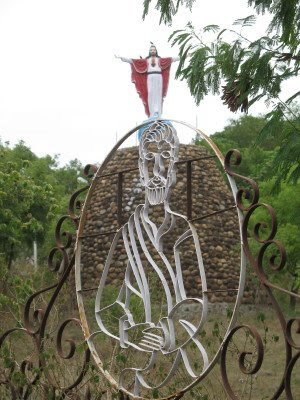
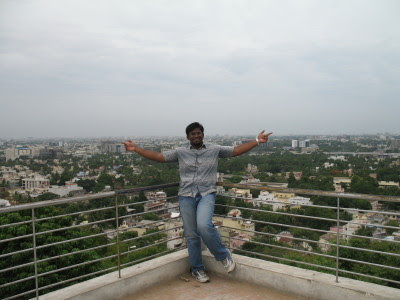
First thing you see as you enter is the sight of Christ Blessing with extended arms.

I guess the figure in steel rails is St. Thomas seen above him is Christ blessing folks that come in.

It is I guess a kind of imitation of one of the 7 new wonders of the World – Christ Redeemer, Rio de Janeiro

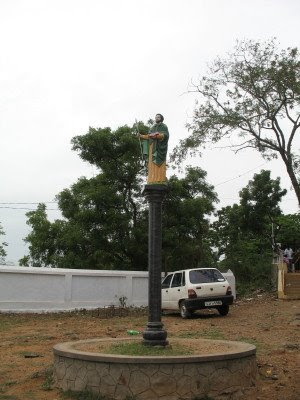
Here is St. Thomas welcoming you…

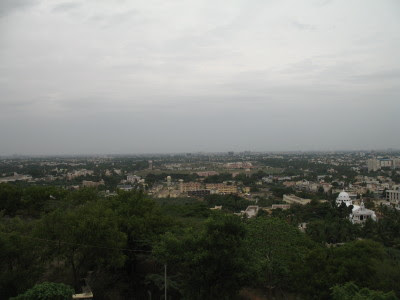
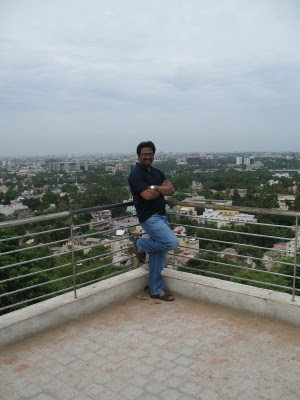
A view of the sprawling civilization down below – more of concrete less of green (inspiration for my poem)

More of green and less of concrete (inspiration for my poem)

A flight going across with the landing gear down for landing at the airport

The Fourth-person view

This tree must have witnessed quite a lot here…

There is something special about this tree, it has been cut so many times but still it has ‘stood’ the test of time though slightly skewed…

Bennett in his new get up…

Me at the tip…

Its Vijay there….

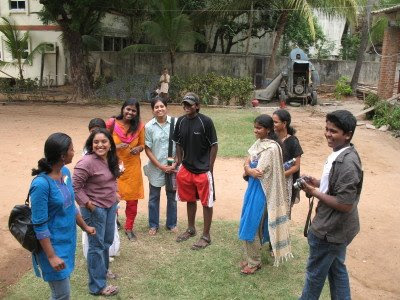
Other folks from youth…

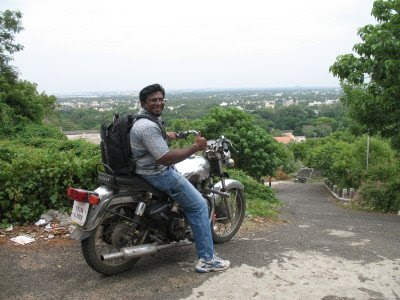
Going down the hill, the steepest descent… in fact Vijay and I went down the hill and then came up and then went down again just for the sake of ‘adrenalin rush’, it was a roller-coaster ride. In one of the bends, I was too fast and had to bank my bike to an acute angle to keep the balance that the foot rest of my bullet gazed the road, it used to happen when I was in college so this was a de javu experience – the footrest of my motor cycle touching the road in the bends.

Lunch chat…. So what’s for lunch???

In life does one walk down the steps or walk up the steps… Plato used the cave analogy to depict enlightenment may be a well analogy would do just as good, except that perhaps the gaint shadows there would reflections here and reflections are more realistic than shadows.

This was a tree in Little Mount that had too much symbolic beauty. It is actually two trees that have merged into one. Symbolic of the metaphysical fact of Christ and the individual living in each other, symbolic of the metaphysical oneness between husband and wife in marriage. I just had to shoot pictures of this metaphysically beautiful tree.

My four good pals in youth. Rufus, Vijay, I and Ashwin (from bottom to top)

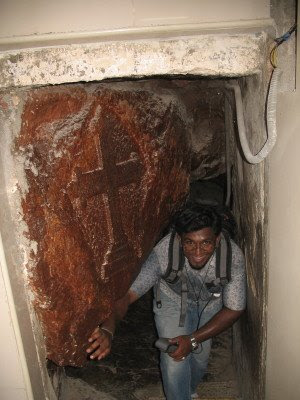
The cave where St. Thomas supposedly lived.

Me emerging out of the cave, actually the idea for this shot was Vijay’s.

The great St. Thomas with his timeless classic quote that even 2000 years after he uttered it is so full of life that it fill us with awe and elevates our spirits to worship God with trembling transcended reverence in our hearts.

I cannot fanthom why God wanted me to miss this bus and not miss the St. Thomas Tour but indeed I had a great time writing poems, cracking jokes, taking snaps and thinking deeply… ‘My Lord, My God’… how great Thou art. Amen

The Portrait of Jennie

The Portrait of Jennie is a black and white movie made in 1948 that I saw recently. It is about an artist finding his inspiration for his work through an imaginary love in his life. The voice-over goes “the winter of the artist is not the cold in the wind but the cold in the indifference of the people towards the beauty around them”. Then there is a tag-line by an art dealer “… an artist must find something he really cares about…”. The movie is about the soul of an artist and the struggles he has to go through to create the divine spark in him.

The movie has some interesting characters Mrs. Spinney an old lady who trades with portraits and sees in Eben her onetime beau, the painter Eben Adams who struggles to find his spark, follow his soul and make a living at the same time, the mechanic Guz who admires Eben and tries to give some pragmatic help. And of course there is Jennie herself played by the great Jennifer Jones who is an actress I like the most. She is awesome when she plays the role of a poignant naive girl who has in her demeanor something deeply mysterious about her. She plays a very similar role in the movie the Song of Bernadette.

>

/emmanuelreagan/2008/03/philosophy-of-song-of-bernadette.html

>

/emmanuelreagan/2008/03/story-of-song-of-bernadette.html

In this movie she appears as the ghost of a dead girl whom Eben Adams falls in love with, completely enamored in her naivety and the timeless mystery that shrouds her. The first time he meets her she is a little girl out alone in the dark and she sings in the most captivating poignant voice “Where I come from nobody knows and where I am going everything goes… The wind blows, the sea flows nobody knows… and where I am going nobody knows” no matter how many times I see this, I feel like I am seeing it for the first time. It is just so full of simplicity, sadness and mystery.

The little girl asks him if he would wait for her to grow up so that she can marry him and then she runs off leaving him wondering how funny the little girl was. He goes home and draws her portrait as a little girl. He captures the melancholy and mystery about the little girl. Mrs. Spinney is impressed.

Now, Eben meets the girl again suddenly she had grown too quickly. They talk and then she goes off only to come back a few days later much grown, grown enough to be married. He draws a portrait of hers and falls in love with her. She goes off again, now he decides to track her and realizes that she had been dead for many years. He goes searching for the place that she got drowned to seek and find himself there as he was lost without her, his inspiration was gone.

The portrait that he does of her is the “Portrait of Jennie”. Mr. Mathews an art dealer comments that it was a stroke of a genius where the essence of a woman had been captured. The essence of a woman says Mr. Mathews is her mystery and timelessness. When Eben and Jennie part for the last time, Jennie tells Eben that his portrait of hers should hang in a Museum which many other girls would come to see her and so it was

In the beginning of the movie, when a disgruntled Ebens tries to sell his passionless paintings to Mrs. Spinney, she tells him “… Andrea Del Sarto drew a perfect hand and Rafael drew a formless claw, Andrea Del Sarto had everything and nothing but Rafael loved his work… poor Andrea Del Sarto (didn’t) …” then she continues “there isn’t a drop of love in any of these (paintings of yours)… an artist must have something he ‘deeply’ cares about” and then buys from him a painting worth less than $2 for $13. When Mr. Mathews questions her as to why she did it, she says that it was not because of what the picture was worth but because of what Eben Adams was worth. In spite of his loveless creation she was able to see something in him that could be unlocked by love and so it was. She tires her best to help him.

Eben has another helper, a mechanic friend Guz who is a kind of a pragmatic philosopher, though that is more of an oxymoron, who empathizes with Eben saying things like, “if there is star-dust in your head, there is a jumble in your soul” and in a way understands and respects the kind of agony Ebens undergoes. Guz gets him a contract to paint and make money, Ebens completes it and gets more fame, a heavier pocket and an empty soul. Guz realizes that he cannot help Ebens much.

There is only one person who can uncork Ebens and that is Jennie or rather the timeless love of Jennie. The movie is a depiction of timeless love in which the pair defy time and space. Unsure of what is to happen of their love, Ebens says ‘the greatest distance I fear now is the distance between today and tomorrow’. It is this ageless romance that kindles in him the flame which would capture that mystery and timelessness of the ‘Portrait of Jennie’.

I LOST and realized it takes courage and confidence to loose

In the debate competition in our company, my team reached semi-finals but couldn’t reach the finals. We lost today. I seldom loose debates, debates are my life-line. I felt the judges were not really fair. I almost laughed aloud when one of the judges said that I was speaking too emotionally and that that was a negative for debates. I couldn’t understand how he thought that I was an emotional speaker, I did not cry neither did I make an attempt to narrate something so poignant so as to make anyone’s eyes wet. I was not emotional, but I was passionate, the judge unfortunately couldn’t differentiate between someone making an emotional speech and someone making a passionate speech. A few folks came and told me that the judgement ought to have been in our favour.

Nevertheless, my team lost. I lost. It was a shock to me, because I never thought I would loose this debate. There haven’t been many things in my life where I really wanted to win but lost. In this debate competition I really wanted to win the finals. I was too passionate about it. I believed I could do that. And the loss in semi-finals, after what I thought was one of the best debates, having to defend the British idea of Monarchy, came in as a rude shock to me.

I was there thinking…

It was then I realized that it takes a lot more courage and confidence to loose in something that one yearnestly wants to win. The courage and confidence to accept oneself even after having failed. The courage and confidence to look at peole and say ‘Yes I lost, but still I am looking you in the eye. Yes, I took a punch, but still I stand ready for the next.’

Just as I was thinking about this a note sent by our HR person in charge of sending out reports about debates made a special mention of our team with the note “Every loss makes the bone as flint, the gristle into muscle and man invincible” made me glader.

In spite of the fact that I am sad that I lost what I passionately wanted to win, I am somehow glad that I ‘experienced’ defeat. Somehow through this loss I as a person am more invincible than I was before in that I can loose something I most yearnestly want to win and still smile 🙂 I thank God for this experience.

Man ‘blinks’ at his Happiness

At a time when all stocks are falling in the US because of the recession induced by the sub-prime fiasco that is getting the US economy by the balls there is one stock that has risen 40% year on year . That is the stock of Netflix, the postal movie rental service.

As people keep loosing jobs, seeing their retirement saving erode, experiencing foreclosure of their homes and their net-worth going down, they still want to keep doing more of one thing which is watching more movies. This again proves the cliché that Hollywood is recession proof.

Here is depicted a need for man to escape reality into a world of fantasy. Why does man want to make this irrational jump? After all he will only live in the real world, he knows fantasy is vanity. After a two hour fantasy ride, he has to come back to the real world and face it brutality.

Of course, generally speaking, movies have the artistic and the entertainment appeal to many folks depending on their (finer) tastes. But the reason for people wanting to escape into fantasy at such times as this belies something more fundamental about human nature and that is man’s yearning for freedom to be happy.

As man finds himself more and more constrained and determined by the happenings around him, he seeks a world, fantasy as it may be which will cater to his sense of freedom to be happy – freedom from having to think and deal with the depressing reality around him, the freedom to plug into the fantasy world and feel as happy as one needs to feel.

There is nothing wrong in employing the creative abilities of human kind to pep up ones spirit. But when this becomes an obsession and an escape route from reality, it would result in a kind of imbalance which would have disastrous effects on human kind’s ability to live a real life. The distinction between the real and the unreal blurs. Even as we analyze our lives there is an eerie feeling that life is getting less and less real.

When Nietzsche said ‘modern man would invent happiness… and then he blinks’, in a sense he foresaw this state of man in which man invents happiness in his fantasy world and then he looses grip with his real life and then once life is does away with all that signifies the real, he ‘blinks’ not knowing what he has to do with happiness anymore now that he isn’t sure what is real and what is unreal.

Words Are Deeds

‘Words are deeds’ said G. K. Chesterton the Prince of Paradox. Some critic may forgive him for his expedient dogmatism for elsewhere as he says ‘word are my trade’.

But the word ‘words’ has taken to have great primacy as the charges have been framed against the now non-existent Bear and Stearns, formerly the fifth largest brokerage firm in the wall street, hedge fund managers Ralph Cioffi and Matthew Tannin.

The case primarily rests on two words they used in the investors conference call where they said that they were ‘cautiously optimistic’ about future prospects of the funds when in fact there was very little optimistic about the performance of the funds. The only apparent pre-‘caution’ Cioffi appears to have taken was to move $2 million of his own money from the fund a month prior to the conference call.

When we live in the pervasive environments of election fever and watch politicians twist and truncate meaning of words to suit their agendas such cases as these where words become all important snap us back to the reality of words in live.

The reality where words will invariably have to be translated to deeds and it is there that they transform from being hot air into being something more tangible. Here the words will have to pass the ‘Test of Truth’. An idea that the politicians, media and general public tend to blithely disregard in the frenzy of being excited about the happenings around the self-important politicians.

‘Words are deeds’, anyone who fails to understand this insight of Chesterton will eventually find the sceptre of Truth haunting him.